
A toilet that keeps running can sound like a minor annoyance, but it wastes water every minute it continues. In addition, most running toilets can be diagnosed and fixed fairly quickly, often without replacing the entire toilet.
The quickest way to fix a running toilet is to first determine why water is continuously moving from the tank into the bowl. In most cases, the problem is a worn flapper, incorrect water level, faulty fill valve, or a problem with the flush handle or chain.

Here’s how homeowners can identify the problem and what to do about it.
What is the quickest way to fix a running toilet?
The quickest fix is usually replacing or adjusting the component that is allowing water to escape from the tank into the bowl.
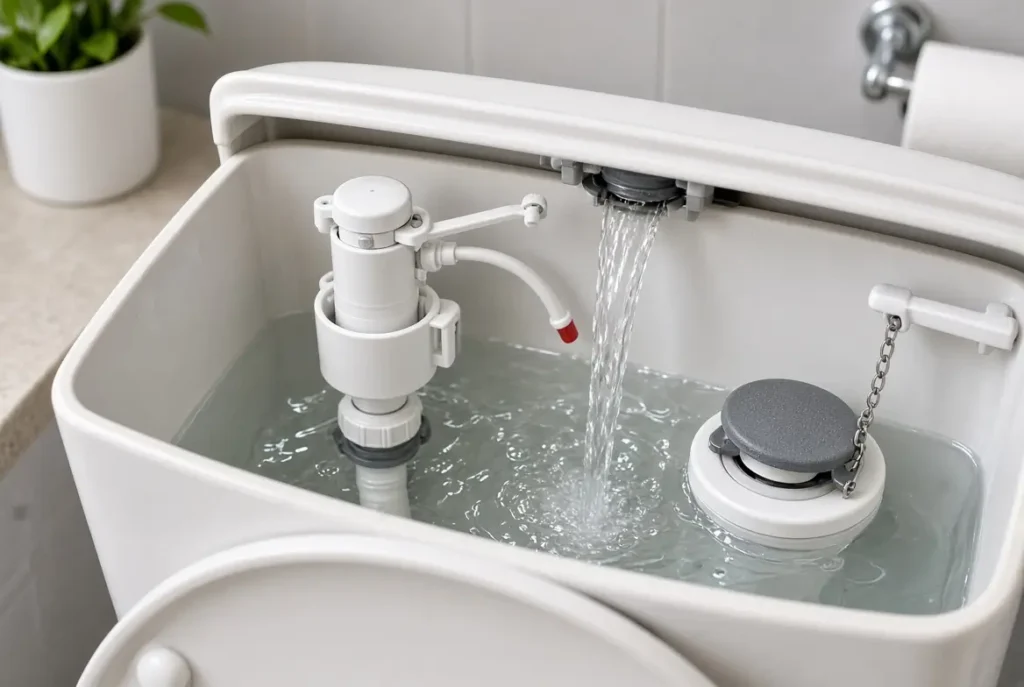
Start by removing the tank lid and watching what happens after you flush.
Check these four areas first:
- The flapper: Is it closing completely?
- The chain: Is it too tight or tangled?
- The water level: Is water rising above the recommended fill line?
- The fill valve: Does it continue running after the tank is full?
If the flapper isn’t sealing properly, replacing it is often the fastest solution. If the water level is too high, adjusting the float may stop the toilet from running.
Why is my toilet constantly running?
A toilet runs continuously when water is entering the tank faster than the system is designed to allow.
The most common causes are:
- A worn-out flapper
- A damaged flush valve
- An improperly adjusted float
- A faulty fill valve
- A chain that’s too tight or too loose
- A toilet handle that doesn’t return properly
- Mineral buildup inside the tank
- Water level set too high
Fortunately, these are usually straightforward plumbing problems.
The key is figuring out where the water is going.
If water is leaking from the tank into the bowl, the flapper or flush valve is a likely culprit. If water is entering the tank and spilling into the overflow tube, the fill valve or float may be the problem.
How do I know if my toilet flapper is bad?
The flapper is one of the first things to check because it creates the seal that keeps tank water from entering the bowl.
Over time, rubber flappers can become:
- Brittle
- Cracked
- Warped
- Stiff
- Covered with mineral deposits
A simple test is to put a few drops of food coloring into the toilet tank. Don’t flush the toilet. Wait approximately 10 to 15 minutes.
If the colored water appears in the bowl, the tank is leaking into the bowl.
That usually means the flapper or another part of the flush valve isn’t sealing correctly.
A replacement flapper is inexpensive and can often be installed in just a few minutes.
Can I fix a running toilet without replacing the flapper?
Sometimes.
If the flapper is still in good condition, the problem may be caused by the chain or the way the flapper is positioned.
A chain that’s too short can prevent the flapper from closing completely. A chain that’s too long can become tangled underneath the flapper.
Make sure the chain has a small amount of slack when the flapper is closed. Also check whether the flapper is sitting evenly on the flush valve opening.
If it looks cracked, warped, or deteriorated, replacing it is usually faster than trying to make an old flapper work properly.
How do I adjust the water level in a running toilet?
Look inside the tank after the toilet finishes filling.
The water should generally stop below the top of the overflow tube or around the marked water line, depending on the toilet design.
If water continues rising and flows into the overflow tube, the tank is overfilled. The adjustment method depends on the type of float.
Some toilets have a ball float attached to an arm. Others use a vertical float attached to the fill valve. A small adjustment to the float can lower the water level and stop the toilet from running. Don’t lower the water excessively, though. Too little water can produce a weak flush.
Why does my toilet keep running after I flush?
If the toilet continues running for a short period after flushing and then stops, that can be normal. The tank needs time to refill. The problem is when the toilet never completely stops or starts and stops randomly throughout the day.
That can indicate:
- A slow leak through the flapper
- A fill valve that isn’t shutting off
- A float that’s incorrectly adjusted
- A damaged flush valve
- Excessive water pressure
- Mineral buildup
A toilet that periodically turns on by itself is often experiencing a small leak from the tank into the bowl. This is sometimes called a “phantom flush.”
What is a phantom flush?
A phantom flush occurs when the toilet appears to flush itself. You may hear the toilet suddenly run for several seconds even though nobody used it.
What’s actually happening is that water has slowly leaked from the tank into the bowl. When the water level falls far enough, the fill valve activates to replace it.
A worn flapper is one of the most common causes. This problem can waste a surprising amount of water over time. If your toilet randomly runs during the night, check the flapper first.
Why is my toilet running but there is no water on the floor?
A running toilet doesn’t necessarily have an external leak.
In fact, most running toilets are leaking inside the toilet. The water is usually moving from the tank into the bowl and then down the drain. That’s why you may hear the toilet running without seeing any water around its base. An external leak is different.
If you see water around the toilet’s base, supply line, or tank connections, you may have a separate plumbing leak that needs attention.
Can a faulty fill valve cause a running toilet?
Yes.
The fill valve controls the flow of fresh water into the toilet tank. When the tank reaches the proper level, the fill valve should shut off.
A failing fill valve may:
- Continue running
- Make humming or squealing sounds
- Fill the tank slowly
- Fail to shut off
- Cause water to enter the overflow tube
If adjusting the float doesn’t solve the problem, replacing the fill valve may be the quickest long-term fix.
How long does it take to replace a toilet flapper?
For a typical toilet, replacing a flapper can take only a few minutes once you have the correct replacement part.
The basic process is:
- Turn off the toilet’s water supply.
- Flush the toilet to empty most of the tank.
- Remove the old flapper.
- Disconnect the chain.
- Attach the new flapper.
- Reconnect the chain with a little slack.
- Turn the water back on.
- Test several flushes.
If the toilet still runs afterward, the flapper may not have been the actual problem.
Should I replace the fill valve or the entire toilet?
Usually, you don’t need to replace the entire toilet just because it runs. A toilet can operate for many years with individual components replaced as they wear out.
Replacing the fill valve, flapper, flush valve, or handle is often much less expensive than replacing an otherwise functional toilet.
A complete toilet replacement may make sense if the toilet has:
- A cracked bowl
- A cracked tank
- Severe corrosion
- Persistent internal problems
- Very poor flushing performance
- Significant mineral buildup
- Frequent repairs
If the porcelain itself is in good condition, repair is often the more practical option.
Can hard water cause a toilet to run?
Yes.
Minerals in hard water can build up inside the tank and around valves and seals. Mineral deposits can prevent the flapper from creating a tight seal or interfere with the fill valve.
Over time, this can lead to:
- Slow leaks
- Weak flushing
- Running water
- A fill valve that doesn’t shut off properly
If multiple plumbing fixtures in your home have mineral buildup, hard water may be contributing to the problem.
Does a running toilet waste a lot of water?
It can.
The amount depends on how much water is escaping and how long the toilet continues running.
A small leak may waste water slowly, while a toilet that continuously sends water down the drain can waste substantially more.
The important point is that the water is being used without providing any benefit. Fixing a running toilet promptly can help prevent unnecessary water waste and potentially reduce your water bill.
Is a running toilet an emergency?
Usually, no.
A running toilet generally isn’t an emergency if the water is staying inside the plumbing system and there is no risk of overflow.
However, it shouldn’t be ignored indefinitely.
You should treat it as more urgent if:
- The toilet won’t stop running
- The bowl is close to overflowing
- Water is leaking onto the floor
- The shutoff valve doesn’t work
- The tank is cracked
- You have a significant plumbing leak
- The toilet is also backing up
If the toilet is actively overflowing, turn off the water supply immediately.
What should I do if my toilet is about to overflow?
If the bowl is filling instead of draining, don’t flush it again. Find the shutoff valve near the base of the toilet and turn it clockwise.
If the toilet doesn’t have a functioning shutoff valve, remove the tank lid and lift the float high enough to stop the fill valve from adding more water. The immediate goal is to stop additional water from entering the toilet.
Once the situation is under control, determine whether you’re dealing with a clog, running toilet, or another plumbing problem.
When should I call a plumber for a running toilet?
A basic flapper or float adjustment is often a reasonable DIY repair.
However, professional help makes sense when the problem continues after replacing common components or when other plumbing symptoms are present.
Call a plumbing or drain professional if:
- The toilet continues running after repairs
- The toilet repeatedly clogs
- The toilet flushes weakly
- Water rises in the bowl
- Other drains are slow
- The toilet gurgles
- You smell sewage
- Water is leaking around the base
- The toilet backs up
- The shutoff valve won’t work
- The toilet has a cracked tank or bowl
A running toilet accompanied by slow drainage, gurgling, or sewage odors may be more than a simple tank repair.
Can a running toilet be connected to a drain problem?
Normally, a running toilet and a clogged drain are separate issues. A running toilet generally involves the tank, flapper, fill valve, or flush mechanism. A clogged drain affects the toilet’s ability to move wastewater away from the bowl.
However, homeowners sometimes notice both problems at the same time. If your toilet is running and flushing slowly, bubbling, backing up, or gurgling, don’t assume replacing the flapper will solve everything. There may be a separate drainage problem that needs to be investigated.
Know Where The Leak Is Coming From First
The quickest way to fix a running toilet is to identify whether water is leaking from the tank into the bowl or whether the fill system isn’t shutting off properly.
Start with the flapper, chain, float, and fill valve. Those components are responsible for many common running-toilet problems and can often be repaired without replacing the toilet.
If a simple adjustment or replacement doesn’t solve the problem—or if your toilet is also slow, gurgling, backing up, or producing sewage odors—there may be a larger plumbing issue involved.
Fixing a running toilet early is usually easier, cheaper, and less wasteful than waiting for a small plumbing problem to turn into a bigger one.